
Food & beverage
Plate heat exchangers for food and beverage processing
Heating, cooling and pasteurising duties where product quality, hygiene and cleaning regimes shape every decision about the exchanger.
Overview
Heat transfer that has to stay clean
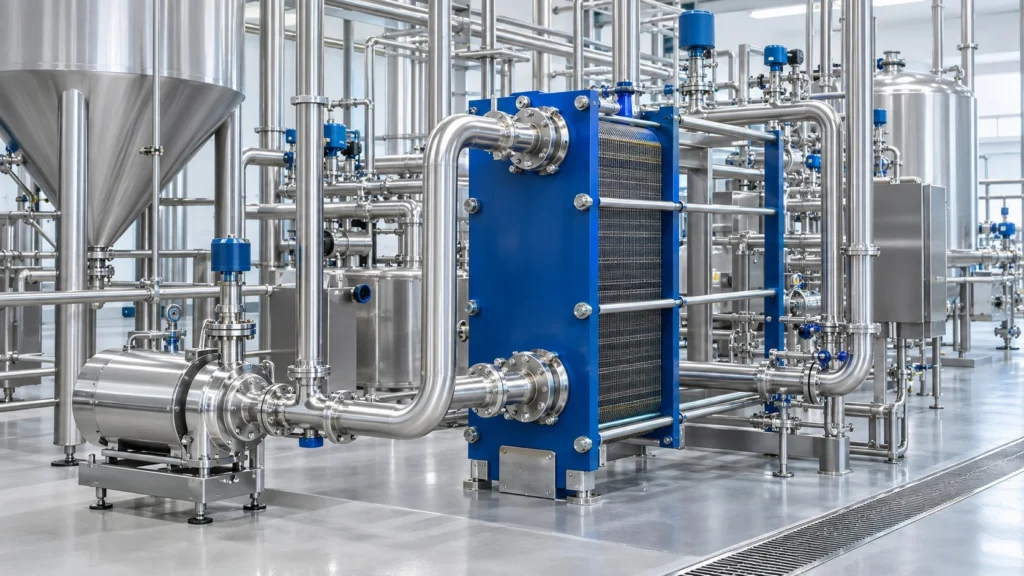
Food and beverage plants rely on plate heat exchangers because they heat and cool product quickly and precisely in a small footprint. The same plates that give that performance also carry product residue, so cleaning and gasket condition matter as much as thermal design.
A failed gasket or a pinholed plate can let product, service water or cleaning solution cross from one side to the other. Regular inspection and crack testing are part of keeping a hygienic process under control.
Applications
Common heat-transfer applications
01
Product heating and cooling
Bringing liquids to process temperature and chilling them afterwards.
02
Pasteurising duties
Heating, holding and regenerative cooling sections.
03
Heat recovery
Using outgoing hot product to preheat incoming product.
04
CIP and utility heating
Heating cleaning solutions and process water.
05
Chilled and glycol water
Cooling duties from refrigeration plant.
06
Beverage processing
Heating and cooling juices, wort, syrups and other liquids.
Challenges
Operating challenges we plan for
- Product fouling and burn-on on hot surfaces
- Frequent cleaning with caustic and acid chemicals
- Gasket compounds that must suit both product and cleaning chemicals
- The consequence of cross-contamination
- Short production shutdown windows
- Tight temperature control for product quality
Services
Relevant services
- Cleaning & regasketing — remove product fouling and renew gaskets
- Workshop servicing — strip-down, crack testing and rebuild
- Maintenance programs — servicing planned into production shutdowns
- On-site servicing — inspection and leak detection on site
Products & parts
Suitable equipment and parts
Maintenance
Maintenance considerations
Things to plan for on food and beverage duties:
- Match gasket compound to both the product and your CIP chemicals
- Crack test plates at workshop services to guard against cross-contamination
- Keep a gasket set on hand for critical units before a planned shutdown
- Record pressure drop and temperatures — a steady rise is often the first sign of fouling
FAQ
Common questions
Which gasket material suits food duties?
It depends on the product, temperature and cleaning chemicals. Tell us all three and we’ll recommend a compound.
Can CIP replace workshop cleaning?
CIP helps keep routine fouling under control. Heavy or burnt-on deposits, and any need to crack test or re-gasket, usually call for the plates to be removed and cleaned individually.
Get in touch
Tell us about your application
Share the duty, the media and the operating environment, and we’ll recommend a practical option.