
Power & energy
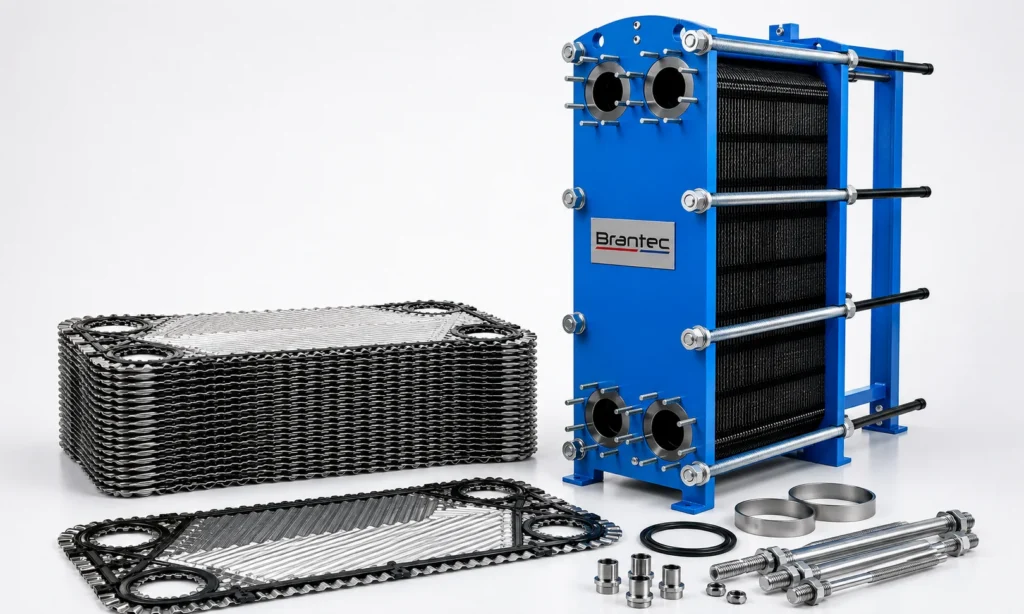
Plate heat exchangers for power and energy
Closed-loop cooling, lube oil cooling and heat recovery all rely on plate heat exchangers that have to keep running between planned outages.
Overview
Keeping critical cooling circuits apart
On power and energy sites, plate heat exchangers commonly separate a clean closed cooling circuit from raw cooling water — river, bore, cooling-tower or seawater — and cool lubricating oil and auxiliary equipment.
Because maintenance usually has to fit into planned outages, the practical priorities are knowing each unit’s condition in advance, having the right gaskets and plates ready, and completing the work inside the outage window.
Applications
Common heat-transfer applications
01
Closed-loop cooling
Isolating clean equipment-cooling circuits from raw cooling water.
02
Lube oil cooling
Cooling lubricating and control oil for turbines, engines and compressors.
03
Engine jacket water
Cooling and heat recovery on gas and reciprocating engine sets.
04
Heat recovery
Transferring waste heat to heating or process circuits.
05
Auxiliary cooling
Pumps, compressors, transformers and other plant equipment.
Challenges
Operating challenges we plan for
- Continuous operation with maintenance only in planned outages
- Fouling and scaling from raw cooling water
- Chloride-bearing water that needs suitable plate materials
- Critical units where a failure affects output
- Units of different makes across one site
Services
Relevant services
- Maintenance programs — condition checks and servicing planned into outages
- Workshop servicing — full strip-down and rebuild
- Cleaning & regasketing — removing scale and fouling
- On-site servicing — inspection and leak detection on site
Products & parts
Suitable equipment and parts
Maintenance
Maintenance considerations
Things to plan for on power and energy sites:
- Inspect units before the outage so parts can be ordered in time
- Hold gasket sets for critical coolers
- Check plate materials against the cooling-water quality
- Trend approach temperature and pressure drop to catch fouling early
FAQ
Common questions
Can you work to an outage schedule?
Yes. Tell us the outage dates and the units involved, and we’ll plan inspection, parts and servicing around them.
What if our cooling water is seawater or brackish?
Chloride-bearing water usually calls for titanium or another resistant plate material. Send us the unit details and water type and we’ll advise.
Get in touch
Tell us about your application
Share the duty, the media and the operating environment, and we’ll recommend a practical option.