
Gasketed plate heat exchangers
Gasketed plate heat exchangers
Highly effective and efficient heat transfer in a compact footprint — with a plate pack that can be opened, cleaned, re-gasketed and expanded.
Overview
How a gasketed plate heat exchanger works
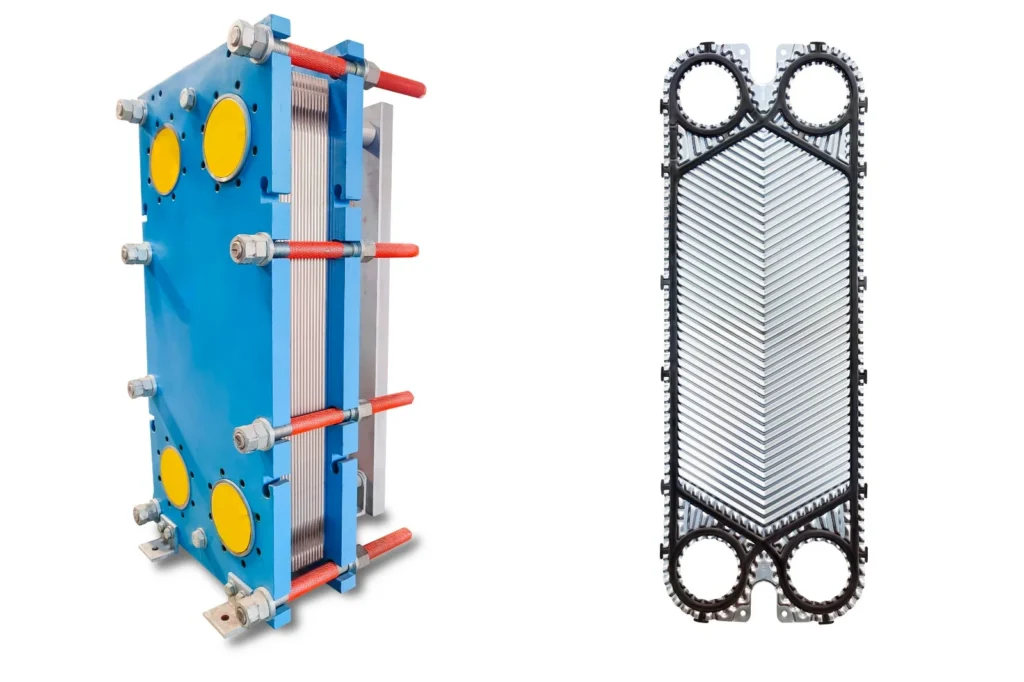
A gasketed plate heat exchanger is a series of embossed metal plates held together between a fixed frame plate and a movable pressure plate by tie bolts. Gaskets around each plate form channels, and the two media flow through alternate channels — separated by the plate, never mixing.
Pressed chevron patterns make the flow turbulent, which gives high heat transfer in a small footprint. Because the pack is held by bolts rather than welded or brazed, it can be opened for cleaning and inspection, re-gasketed, and often expanded with extra plates.
Applications
Typical applications
Heating and cooling
Process heating and cooling, heat recovery and interchanger duties.
Building services
Pressure breaks between primary and secondary HVAC circuits.
Hygienic processes
Food and beverage heating, cooling and pasteurising duties.
Utility cooling
Engine, compressor and hydraulic cooling with water or glycol.
Fouling media
Duties where plates need to be opened and cleaned regularly.
Expansion over time
Plants that may need more capacity later.
Materials & configurations
Materials and configurations
Plates are commonly stainless steel, with titanium and other corrosion-resistant options for aggressive media such as seawater. Gaskets such as NBR, EPDM and Viton are selected for the media, temperature and cleaning chemicals.
Frames range from small units to large industrial exchangers; the frame size sets how many plates the unit can take.
Identification
What we need to identify the right part
For parts or a replacement for an existing gasketed unit, the nameplate is the best starting point.
- Manufacturer and model
- Serial number from the nameplate
- Number of plates in the pack
- Plate dimensions and port positions, if the nameplate is missing
- Plate and gasket material, if known
- Photos of the nameplate, the unit and a plate
Compatibility
Compatibility and correct selection
Plates must match the model, plate pattern, port arrangement and material; gaskets must match the plate groove and suit the media and temperature. Our standard supply is high-quality compatible parts that match or exceed the original OEM specification — the practical, cost-effective choice for most repairs. Genuine OEM parts are available on request.
Every plate and gasket is inspected by the Brantec team for quality and consistency before supply.
FAQ
Common questions
Can an existing plate heat exchanger be expanded?
Often, yes — many frames allow extra plates to be added to increase capacity. We’ll check the frame and duty before recommending it.
How long do gaskets last?
It depends on temperature, media and cleaning. We’ll assess gasket condition during a service.
Do you service gasketed units from other manufacturers?
We service and supply parts for many common makes. Send us the nameplate details and we’ll confirm.
Related
Related services and products
Replacement plates
Plates matched to your unit’s model, pattern and material.
Replacement gaskets
NBR, EPDM and Viton gaskets selected for your media and temperature.
Workshop servicing
Full strip-down, clean, crack test, re-gasket and rebuild at our Granville workshop.
Get in touch
Need a gasketed unit or parts?
Send the nameplate details or a photo and we’ll confirm what suits your unit.